AP U.S. GOVERNMENT & POLITICS · [school year]
1.1. Assignments & Activities
Unit 1: Foundations of American Democracy
Mr. Cutler · [date to assign] · [class day], [class day], [class day], [class day]
Essential question: How did the framers attempt to protect individual liberty while promoting public order and safety—and does their design still work?
Schedule update: We have already covered Federalist No. 51; upcoming references are review and application. Adam Smith was introduced on [class day], [date to assign]. [date to assign] update: Mr. Cutler will be present for the amendments simulation. Lepore’s article and quiz remain due [class day], [date to assign].
How to read this page
IN CLASS: What we do together during the listed class.
HOMEWORK / PREPARATION: What to complete or prepare after class. Read the stated due date.
DUE TODAY: An assignment or assessment due on the date shown.
AP ESSENTIAL: Required AP content or skills. A “preview” label means required material from a later AP unit that we introduce early.
HELPFUL CONTEXT / CED OPTIONAL: Background or an additional source that helps explain the core material. Its CED status does not cancel an assigned class task.
AP requirements and class assignments are different. The CED is College Board’s Course and Exam Description. “CED optional” means a source is not required AP memorization. Complete every assigned class activity, reading, and quiz unless it explicitly says “Optional practice.” An enrichment reading can still have a required class assignment. Use the class review materials to determine the scope of our unit test.
What is essential, and what is extra?
| Material | AP status and study priority |
|---|---|
| Declaration; Articles of Confederation; Constitution, including the Bill of Rights; Federalist Nos. 10, 39, and 51; Brutus No. 1 | REQUIRED DOCUMENTS. Know the arguments and connect them to the constitutional principles we study. |
| Gettysburg Address | REQUIRED DOCUMENT; Topic 1.1. Connect equality and government by the people to the Declaration. A separate source lesson will address this document; it is not part of the [date to assign] simulation. |
| Adam Smith: core principles from The Wealth of Nations | REQUIRED; Unit 4 preview. Introduced [date to assign]. Prioritize free enterprise, self-interest, competition, resource allocation, and limited market regulation. Detailed economic theory is enrichment. |
| Federalist No. 78 and Marbury v. Madison | REQUIRED; Unit 2 preview. We introduce the judiciary material early to connect it to constitutional checks. |
| McCulloch v. Maryland and United States v. Lopez | REQUIRED CASES; Topic 1.8. Study the facts, constitutional issue, holding, and reasoning. Practice comparing the decisions. |
| Emancipation Proclamation; 13th and 14th Amendments; incorporation | REQUIRED COURSE MATERIAL. Briefly previewed through the [date to assign] simulation and revisited in depth in later units. Distinguish executive wartime action, constitutional abolition, and the protection of rights against state action. |
| Locke and Hobbes readings; Federalist No. 68 | CED OPTIONAL SOURCES. Helpful for understanding required ideas. The social contract, natural rights, and Electoral College remain essential concepts. |
| Lepore’s article; Raich; Comstock | ADDITIONAL SOURCES. These are not required AP documents or cases. The assigned article quiz and case-comparison activity remain required classwork. |
| Videos, simulations, Kahoot, current examples, and textbook exercises | LEARNING AND PRACTICE TOOLS. Complete assigned work; prioritize the concepts and skills it develops. |
2026–27 update: Federalist No. 39, the Gettysburg Address, the Emancipation Proclamation, and Adam Smith’s core principles are new required additions. See College Board’s update and the current CED (printed pp. 25–30, 40–51, 68, and 102).
This is a Unit 1 schedule, not the full-year document list. Other required texts, including Federalist No. 70 and “Letter from a Birmingham Jail,” belong in later parts of the course.
Federalist readings: essential passages and AP takeaways
Use the reading buttons under the class dates below. Each button opens the assigned selections with exact start and stop words, source links, and highlighted AP GoPo: Know and Apply guidance. Read only those ranges; full papers are optional context.
Jump to the reading buttons: No. 10 · No. 51: review · No. 78 · No. 39 · No. 70: later study · No. 68: excerpt only
These are instructional selections, not an official College Board excerpt list. Required-document status means you must understand and apply the central argument. No. 70 is for later Unit 2 study, not an additional assignment this week.
Reading expectations: You remain responsible for the content we cover, even when I do not assign every textbook page. Use class notes and InQuizitive feedback to identify sections you need to revisit.
Textbook pages: Page references retain our current Election Update reading schedule. Chapter 3 is divided into pp. 88–96, 97–113, and 113–122. AP Study Guide question sets begin on pp. 36, 84, 85, and 123.
Jump to: Opening classes · [date to assign] · [date to assign] · [date to assign] · [date to assign] · Review and test
Opening classes · [date to assign]
[class day], [date to assign] · Day 1
Welcome to AP Government
Schedule note: Special schedule: morning meeting, advisory, homeroom, and short class meetings.
IN CLASS: Introductions, syllabus review, course expectations, and an introductory Kahoot with an anonymous quiz.
EXIT TICKET / WRITTEN CHECK: What is one thing you hope to learn in this course?
HOMEWORK / PREPARATION: Read the syllabus and get your textbook. For [class day], [date to assign].
[class day], [date to assign] · Day 2
Course expectations and the purpose of government
IN CLASS: Continue introductions and review the syllabus, learning objectives, and expectations. Discuss the role of government in society.
AP ESSENTIAL: Begin connecting government’s purpose to liberty, order, and democratic principles.
HOMEWORK / PREPARATION: None — camp.
No class: [date to assign], Upper School camp at Camp JORI. Class of 2027 evening activity at Kings in Dedham on [date to assign]. No school: [date to assign], extended Labor Day weekend; [date to assign], Labor Day.
[class day], [date to assign] · Day 3
Summer reading assessment
IN CLASS: Take the summer reading comprehension test. Afterward, begin a brief introduction to Unit 1.
HOMEWORK / PREPARATION: Due [class day], [date to assign]: Read Chapter 1, pp. 6–8, “Why do we have a government?” Answer AP Study Guide questions 1, 3, and 4, beginning on p. 36. Prepare to share your responses.
[class day], [date to assign] · Day 4
Enlightenment foundations
IN CLASS: Review democratic ideals, then complete the FlintAI comparison activity. Compare Locke and Hobbes on the state of nature, sovereign power, and the social contract. Read selected passages from Locke, Second Treatise of Government and Hobbes, Leviathan, Part II.
AP ESSENTIAL: Topic 1.1: Natural rights, social contract, popular sovereignty, limited government, and their expression in American founding documents.
HELPFUL CONTEXT / CED OPTIONAL: Locke and Hobbes: These readings support our understanding of required ideas. Their complete works and detailed philosophical differences are not required foundational-document memorization.
EXIT TICKET / WRITTEN CHECK: How do the Declaration’s ideals still influence American politics?
HOMEWORK / PREPARATION: Homework #2 — due [class day], [date to assign]: Read the Declaration of Independence and complete the homework portion of the FlintAI activity.
[class day], [date to assign] · Day 5
Declaration of Independence
IN CLASS: Continue the Declaration close reading and connect its arguments to our Enlightenment discussion. Listen to John F. Kennedy’s reading of the Declaration. Annotate the opening ideals, select five grievances you consider most serious, and identify the colonists’ proposed action in the conclusion.
IN CLASS ACTIVITY
Declaration of Independence: Close Reading
Explore natural rights, consent, popular sovereignty, and limited government through provided excerpts and explanations.
Use for close reading and review. Record your explanations in your notebook before opening the model responses. The authorship investigation is enrichment.
Opens in a new tab. No additional account or login is required.
AP ESSENTIAL: Required document: Declaration of Independence. Explain natural rights, consent, social contract, and limited government. Connect these to popular sovereignty and republicanism.
HELPFUL CONTEXT / CED OPTIONAL: The recording and Locke/Hobbes comparisons are learning tools. Focus your AP review on the document’s claims and the democratic principles it illustrates.
EXIT TICKET / WRITTEN CHECK: Explain how one idea associated with Locke appears in the Declaration.
HOMEWORK / PREPARATION: None — Rosh Hashanah no-homework weekend.
[date to assign] · Founding arguments and Adam Smith
[class day], [date to assign] · Day 6
Federalist No. 10 and Brutus No. 1: introduction
IN CLASS: Begin the selected Federalist No. 10 passages and the Brutus No. 1 work in class following the no-homework weekend. Bell ringer: the democracy-models infographic on p. 37, questions 7–8. Distinguish participatory, pluralist, and elite democracy. In pairs or trios, complete the Federalist No. 10 and Brutus No. 1 team challenge below. The activity supplies the passages, questions, hints, and practice points.
Read only the 5 selected passages. The guide provides exact start and stop words, source links, and highlighted AP GoPo: Know and Apply guidance.
Read Federalist No. 10: passages & AP takeaways
Opens in a new tab.
IN CLASS ACTIVITY
Federalist No. 10 & Brutus No. 1: Team Challenge
Can a large republic protect liberty? Compare the authors’ arguments using the passages provided in the activity.
About 40 minutes · Teams of 2–3. Discuss each choice, use the hints when needed, and earn practice points. Each student should keep notes on the competing arguments.
Opens in a new tab. No additional account or login is required.
AP ESSENTIAL: Topics 1.2–1.3: Both documents are required. Identify their competing arguments about representation, the size of a republic, national power, and individual liberty.
EXIT TICKET / WRITTEN CHECK: Which democratic ideal is most challenged today? Support your answer.
HOMEWORK / PREPARATION: Homework #3 — due [class day], [date to assign]: Finish Federalist No. 10: selected essential passages and AP takeaways and Brutus No. 1. Bring annotations for our comparison activity.
[class day], [date to assign] · Day 7
Factions, representation, and safeguards against power
IN CLASS: Apply Madison’s argument about factions to modern groups. Compare Federalist No. 10 with Brutus No. 1. Build a chart with three columns: democracy model / evidence from either document / contemporary example. Review our already-completed work on Federalist No. 51: selected passages and AP takeaways to connect these arguments to separation of powers, checks and balances, and federalism. Use AP Study Guide questions 2–4 beginning on p. 84.
Read only the 3 selected passages. The guide provides exact start and stop words, source links, and highlighted AP GoPo: Know and Apply guidance.
Review Federalist No. 51: passages & AP takeaways
Opens in a new tab.
IN CLASS ACTIVITY
Factions, Democracy, and the Protection of Liberty
Use seven provided passages, a completed example, and sentence starters to build your democracy-models chart. Connect the comparison to our completed Federalist No. 51 work.
Pairs or trios. Each student completes a chart and the written responses in a notebook. Use the activity’s study-guide directions and exit prompt for the comparison work.
Opens in a new tab. No additional account or login is required.
AP ESSENTIAL: Topics 1.2, 1.3, and 1.6: Distinguish the large-republic solution in No. 10, the warnings in Brutus No. 1, and the institutional safeguards in No. 51. All three texts are required.
HELPFUL CONTEXT / CED OPTIONAL: Federalist No. 68: excerpt only: The p. 38 excerpt and questions 9–10 provide additional practice. No. 68 is not on the required document list; the Electoral College is required course content.
EXIT TICKET / WRITTEN CHECK: Do you agree with Madison’s solution to factions? Use evidence.
HOMEWORK / PREPARATION: For [class day], [date to assign]: Review your Enlightenment and Declaration notes. Prepare to connect political liberty and self-interest to Adam Smith. No new Federalist No. 51 reading.
[class day], [date to assign] · Day 8
Adam Smith and economic liberty
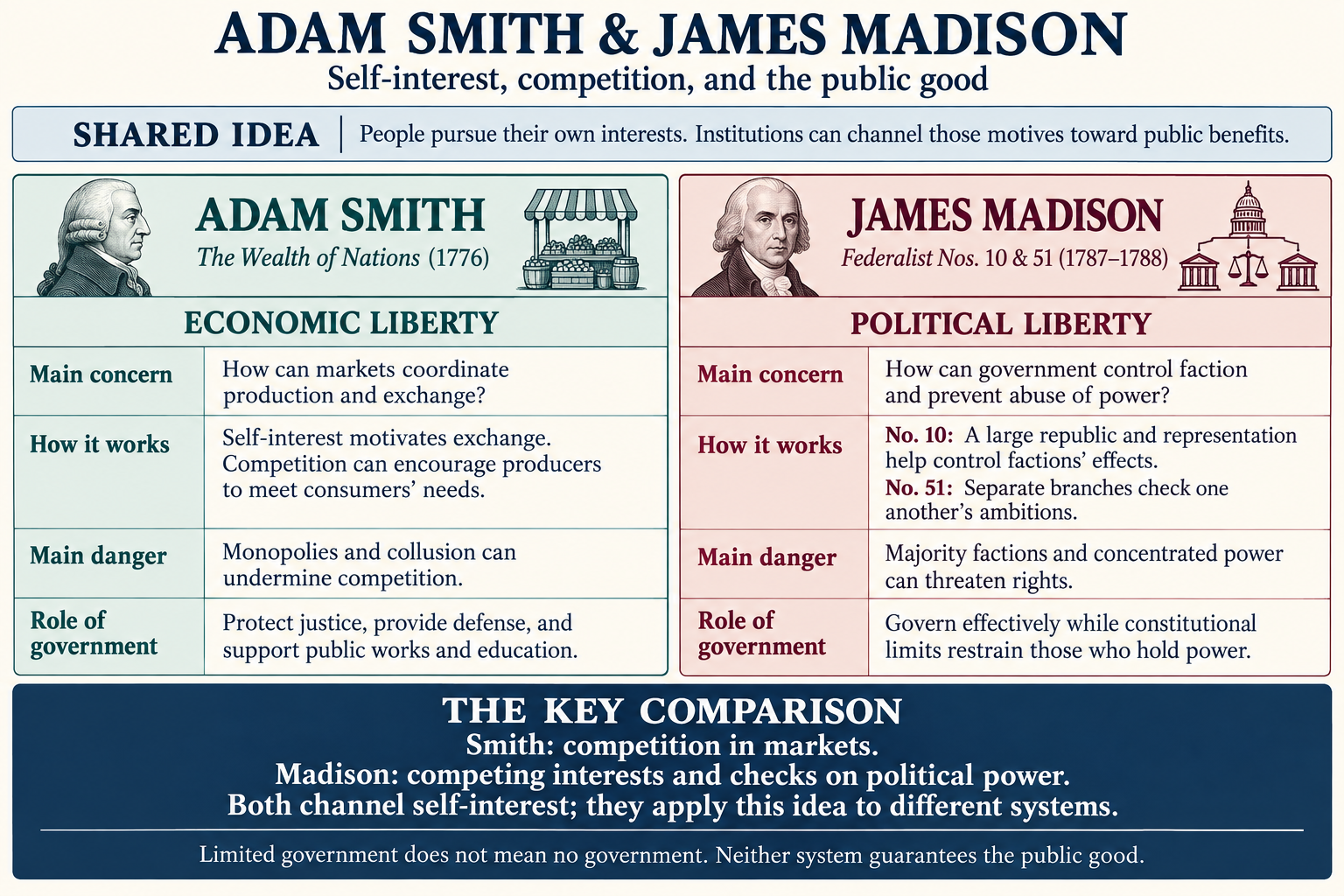
Select the comparison graphic to view it at full size.
🧠 LEARNING AND PRACTICE TOOLS. Complete assigned work; prioritize the concepts and skills it develops.
DUE TODAY: Chapter 1 InQuizitive.
IN CLASS: Introduce activity and core principles from The Wealth of Nations. Read selected excerpts together and explain self-interest, market competition, resource allocation, and limited government regulation. Use the pin-factory example to explore specialization. Compare Smith’s treatment of self-interest with Madison’s checks and balances in Federalist No. 51.
IN CLASS ACTIVITY
Adam Smith & James Madison
Explore self-interest, specialization, competition, and the role of government. Then compare Smith’s ideas with Madison’s argument in Federalist No. 51.
About 50 minutes. Keep your written responses in your notebook.
Open the Smith & Madison activity
Opens in a new tab. No additional account or login is required.
AP ESSENTIAL: Required for 2026–27 — Unit 4 preview, Topic 4.1: Know Smith’s connection to free enterprise: self-interest, competition, efficient resource allocation, and limited government regulation of markets.
HELPFUL CONTEXT / CED OPTIONAL: The pin-factory details, extended economic theory, and a detailed Smith–Locke–Madison comparison deepen understanding. Reading the entire book is not assigned. Limited government does not mean no government.
EXIT TICKET / WRITTEN CHECK: Complete the Madison & Smith practice activity. Respond before reviewing the answers and explanations.
HOMEWORK / PREPARATION: Homework #4 — due [class day], [date to assign]: Read the Articles of Confederation.
[class day], [date to assign] · Day 9
Articles of Confederation
IN CLASS: Analyze the Articles’ structure and weaknesses. Discuss what happens when states retain extensive power and the national government struggles to act. Use the chart on p. 49. Connect Shays’ Rebellion, taxation and enforcement problems, the absence of a separate executive and general national judiciary, interstate commerce, and currency issues.
IN CLASS ACTIVITY
Articles of Confederation: Powers and Problems
Use the explanations, document excerpts, and practice questions to connect weaknesses in the Articles to demands for a stronger national government.
Pairs or trios. Focus on the sections assigned in class. Explain a provision, the problem it created, and a later constitutional response before opening the model answer.
Opens in a new tab. No additional account or login is required.
AP ESSENTIAL: Topic 1.4 — required document: Explain how weaknesses in the Articles helped produce demands for a stronger national government. Congress could coin money; it lacked exclusive coinage power.
EXIT TICKET / WRITTEN CHECK: Which weakness most seriously undermined the Confederation? Explain.
HOMEWORK / PREPARATION: Homework #5 — due [class day], [date to assign]: Read Chapter 2, pp. 40–49, focusing on the circumstances that led to the Constitutional Convention. Keep the reading light and plan around Yom Kippur.
[class day], [date to assign]: No class — Yom Kippur.
[date to assign] · Constitution and ratification
[class day], [date to assign] · Day 10
From the Articles to the Constitution
IN CLASS: Compare powers under the Articles and the Constitution. Connect the changes to the Federalist–Anti-Federalist debate. In pairs or trios, use pp. 50–59 to build an organizer on the Great Compromise, Electoral College, Three-Fifths Compromise, slave-importation provision, and the later ratification assurances about a Bill of Rights.
IN CLASS ACTIVITY
From the Articles to the Constitution
Compare governing powers and build an organizer on the five constitutional settlements in today’s lesson. The activity includes the Convention guide and links to the Articles evidence.
About 50 minutes · Pairs or trios · 20 practice points. Start with the directions at the top of the page. Each student keeps the organizer and ratification argument in a notebook.
Opens in a new tab. No additional account or login is required.
AP ESSENTIAL: Topics 1.4–1.5: Explain how negotiation shaped the Constitution and how proposed constitutional changes addressed weaknesses of the Articles.
EXIT TICKET / WRITTEN CHECK: Would Federalists or Anti-Federalists be more satisfied with government today? Explain.
HOMEWORK / PREPARATION: For [class day], [date to assign]: Continue the assigned Chapter 2 reading.
[class day], [date to assign] · Day 11
Constitutional compromises and amendment process
IN CLASS: Role-play states’ interests in the Great Compromise, Three-Fifths Compromise, Electoral College, and commerce/slave-trade negotiations. Introduce Marbury v. Madison (1803) as a connection to constitutional checks. Use “Amending the Constitution,” p. 74, and Table 2.1, p. 75, to distinguish proposal from ratification.
IN CLASS ACTIVITY #1
Marbury V. Madison (1803), plus a preview of Federalist 78
Return to the Convention guide for the state-interest role-play and the amendment-process lesson.
Learn the essential components of the required SCOTUS case. Explain the important of judicial review and SCOTUS enhancing the scope of its power.
IN CLASS ACTIVITY #2
Convention Compromises & Article V
Return to the Convention guide for the state-interest role-play and the amendment-process lesson.
Use the essential-compromises and Article V sections. Explain who gained influence, what the settlement changed, and how amendment proposal differs from ratification.
Opens in a new tab. No additional account or login is required.
AP ESSENTIAL: Topic 1.5: Know the major compromises and Article V. Required Unit 2 preview: Marbury and judicial review.
HELPFUL CONTEXT / CED OPTIONAL: All adopted amendments were proposed by Congress. The Twenty-first Amendment was unusual because state conventions ratified it. See the National Archives: amendment process.
EXIT TICKET / WRITTEN CHECK: Which compromise was most essential to securing agreement? Defend your answer.
HOMEWORK / PREPARATION: Due [class day], [date to assign]: Finish the assigned Chapter 2 reading.
[class day], [date to assign] · Day 12
Ratification and the Bill of Rights
Schedule note: Sukkot begins at sundown. Please plan with observing students in mind.
IN CLASS: QUIZ. Examine why opponents wanted explicit protections for individual liberty. Rank amendments and apply them to scenarios. Watch selected portions of Annenberg: “Key Constitutional Concepts”; discuss Shays’ Rebellion, checks and balances, Article V, and the original absence of a Bill of Rights. Use the Take-a-Stand activity on p. 73 for a seminar on constitutional interpretation. Alternative written practice: AP Study Guide questions 5–9 beginning on p. 85.
IN CLASS ACTIVITY
Would You Ratify?
Weigh Federalist and Anti-Federalist arguments, then test how a specific Bill of Rights protection addresses a concern about national power.
About 15 minutes · Pairs or trios · 12 practice points. Use this during the ratification discussion. Write before opening the hints and explanations.
Open the ratification activity
Opens in a new tab. No additional account or login is required.
AP ESSENTIAL: Topic 1.5; Unit 3 preview: Constitution and Bill of Rights. Connect the ratification debate to protections for individual liberty.
HELPFUL CONTEXT / CED OPTIONAL: The video and seminar format are instructional choices. Constitutional principles and the relevant rights remain essential content.
EXIT TICKET / WRITTEN CHECK: How did the Bill of Rights address Anti-Federalist concerns?
HOMEWORK / PREPARATION: Homework #7 — due [class day], [date to assign]: Read the Bill of Rights, Amendments 1–10. Begin for [class day], [date to assign]: Jill Lepore, “How Originalism Killed the Constitution”. This is assigned enrichment with a required class quiz; it is not a required AP foundational document.
[date to assign] · Rights, courts, and federalism
[class day], [date to assign] · Day 13
Who protects a right? A preview of the 13th and 14th Amendments
Schedule update: Mr. Cutler will be present. We will complete a guided lesson and simulation together.
DUE TODAY: Chapter 2 InQuizitive and the previously assigned Bill of Rights reading.
IN CLASS: Begin with a Bill of Rights retrieval question: which government did its protections originally restrict? Preview the relevant provisions of the 13th and 14th Amendments with Mr. Cutler: 13th Amendment, Sections 1–2; 14th Amendment, Sections 1 and 5. Then open the simulation using the button below. Focus on constitutional mechanisms and the national–state relationship.
Who Protects a Right? · About 28 minutes. Preview the 13th and 14th Amendments through eight decisions. Distinguish the wartime proclamation from constitutional abolition; apply citizenship, due process, equal protection, and incorporation.
Open [class day]’s amendments simulation
Opens in a new tab.
AP ESSENTIAL — PREVIEW: Unit 1 connections: limited government, federalism, and Article V. Unit 3 preview: civil liberties and civil rights; the 13th Amendment’s abolition of slavery; the 14th Amendment’s citizenship, Due Process, and Equal Protection Clauses; and selective incorporation. Know that most Bill of Rights protections apply to state and local governments through court decisions, generally using the 14th Amendment’s Due Process Clause. This developed over time; it was not automatic total incorporation in 1868.
LESSON SCOPE: Today introduces concepts that we will revisit in depth. The proclamation appears only to clarify the distinction between a wartime executive action and constitutional abolition. No full-document comparison with the Declaration is assigned today, and no new Supreme Court case memorization is required for this preview.
EXIT TICKET / WRITTEN CHECK: In 3–4 sentences, distinguish the proclamation from the 13th Amendment. Then identify one 14th Amendment protection and apply it to a state or local government action.
HOMEWORK / PREPARATION: For [class day], [date to assign]: Prepare for the scheduled multiple-choice quiz using the previously announced scope. Due [class day], [date to assign]: Continue Jill Lepore, “How Originalism Killed the Constitution”. Be ready to identify the thesis, one supporting example, and one question or counterargument. The article quiz remains scheduled for [class day]; we will complete its simulation in class afterward.
[class day], [date to assign] · Day 14
Federalist No. 78 and constitutional checks
IN CLASS: Take the scheduled multiple-choice quiz. Read Federalist No. 78: selected essential passages and AP takeaways in class and practice AP free-response questions. In pairs, search Articles I–III of the U.S. Constitution: who declares war, taxes, creates lower federal courts, impeaches, tries impeachments, and selects judges? Cite the relevant provisions. Compare pp. 64–65 and discuss the p. 65 Critical Thinking questions.
Read only the 4 selected passages. The guide provides exact start and stop words, source links, and highlighted AP GoPo: Know and Apply guidance.
Read Federalist No. 78: passages & AP takeaways
Opens in a new tab.
IN CLASS ACTIVITY
Who Checks the Court?
Connect Federalist No. 78, judicial independence, and Marbury v. Madison. Explain how the judiciary can restrain power while remaining subject to constitutional limits.
About 15 minutes after the quiz · Pairs or trios · 12 practice points. Use this for the judiciary portion of today’s constitutional-checks practice.
Open the judicial-checks activity
Opens in a new tab. No additional account or login is required.
AP ESSENTIAL: Topic 1.6; Topic 2.8 preview: Checks and balances, judicial independence, and judicial review. Federalist No. 78 and Marbury are required AP material even though we introduce them before the judiciary unit.
EXIT TICKET / WRITTEN CHECK: Explain how impeachment functions as a check and balance.
HOMEWORK / PREPARATION: Homework #8 — due [class day], [date to assign]: Read Chapter 3, pp. 88–96. Finish Jill Lepore, “How Originalism Killed the Constitution” and prepare for the article quiz on [class day].
[class day], [date to assign] · Day 15
Constitutional change: amend, interpret, or legislate?
DUE TODAY: Jill Lepore, “How Originalism Killed the Constitution”; the multiple-choice article quiz; and Chapter 3, pp. 88–96. The article is a required class reading, although it is not a required AP foundational document.
IN CLASS: Take the article quiz, then open the simulation using the button below to evaluate constitutional change. Discuss three brief Lepore excerpts with questions, test Article V vote thresholds, hold an interpretation hearing, and write an individual verdict. Finish by distinguishing checks and balances among branches from federalism between national and state governments.
Amend, Interpret, or Legislate? · About 25 minutes. The activity includes three short Lepore excerpts, discussion questions, an Article V vote exercise, and an individual verdict. Support or challenge the article with evidence.
Open [class day]’s Lepore simulation & discussion
Opens in a new tab.
AP ESSENTIAL: Topics 1.5–1.7: Article V, checks and balances, and federalism. Distinguish formal changes to constitutional text from judicial interpretation and ordinary legislation. For the congressional proposal route, Article V requires two-thirds of each house and ratification by three-fourths of the states. The president has no formal approval or veto role. Connect judicial review to the Federalist No. 78 work from [class day].
HELPFUL CONTEXT / CED OPTIONAL: Lepore’s article: Assigned enrichment. Distinguish the author’s argument, historical evidence, and your own inference. Original public meaning can apply to new technology; considering changed circumstances does not give judges unlimited freedom to replace constitutional text. Both approaches require careful reasoning. Detailed debates among interpretive theories are enrichment.
Who Has the Power? — Part A reference
Use the existing examples to check your labels for branches, checks and balances, and levels of government during the photo activity. We will continue fiscal federalism on [date to assign].
EXIT TICKET / WRITTEN CHECK: What is the difference between changing constitutional text and changing how existing text applies? Explain one advantage and one cost of a difficult amendment process.
HOMEWORK / PREPARATION: Homework #9 — due [class day], [date to assign]: Read Chapter 3, pp. 97–113, focusing on changing interpretations of national and state power.
[class day], [date to assign] · Day 16
Federalist No. 39: national and federal features
IN CLASS: Read Federalist No. 39: selected essential passages and AP takeaways. Chart the Constitution’s national and federal features through ratification, the House, Senate, presidency, and amendment process. Connect the chart to the ratification debate and the distribution of power.
Read only the 5 selected passages. The guide provides exact start and stop words, source links, and highlighted AP GoPo: Know and Apply guidance.
Read Federalist No. 39: passages & AP takeaways
Opens in a new tab.
IN CLASS ACTIVITY
Federalist No. 39: National, Federal, or Both?
Use Madison’s definitions and supplied evidence to classify the House, Senate, presidency, ratification, amendment, and the operation of national laws.
About 15 minutes · Pairs or trios · 12 practice points. Begin with the completed House example, then build your chart and explain each classification.
Open the Federalist No. 39 activity
Opens in a new tab. No additional account or login is required.
AP ESSENTIAL: Required for 2026–27 — Topic 1.7: Explain republican government and the Constitution’s combination of national and federal features. No. 39 is an AP essential.
EXIT TICKET / WRITTEN CHECK: Is the Constitution more national or more federal? Use a specific feature to defend your answer.
HOMEWORK / PREPARATION: For [class day], [date to assign]: Review your Federalist No. 39 chart.
[date to assign] · Federalism and Supreme Court cases
[class day], [date to assign] · Day 17
Federalism in action: Part 1
IN CLASS: Lecture and application: powers of the national and state governments; exclusive, reserved, and concurrent powers; fiscal federalism; and intergovernmental relationships. Connect policy examples to Federalist No. 39.
IN CLASS ACTIVITY
Who Has the Power? — Part B
Classify revenue sharing, block grants, categorical grants, and mandates. Explain how each arrangement affects state discretion and national policy goals.
About 12 minutes · Pairs or trios · 12 practice points. Complete Part B during the fiscal-federalism lesson and defend a funding recommendation.
Opens in a new tab. No additional account or login is required.
AP ESSENTIAL: Topic 1.7: Explain how national and state powers interact, including how funding arrangements influence policymaking.
EXIT TICKET / WRITTEN CHECK: How might the framers evaluate modern federalism?
HOMEWORK / PREPARATION: No new assignment listed. Optional practice: review your federalism notes and identify one example of shared power.
[class day], [date to assign] · Day 18
Federalism in action: Part 2
IN CLASS: Use Kahoot, policy examples, and FRQ practice to apply federalism. Work with the argument essay prompt on p. 127. Research how the three federal branches and your state plus two others responded to COVID-19, then write and review the argument in class. Your claim may differ from your initial position.
AP ESSENTIAL: Topic 1.9: Explain how the division of power affects policymaking. Practice a defensible thesis, relevant evidence, and reasoning.
HELPFUL CONTEXT / CED OPTIONAL: COVID-19 and disaster responses are examples for applying required concepts. Detailed memorization of every policy example is enrichment.
EXIT TICKET / WRITTEN CHECK: Use the rubric to identify one strength and one needed improvement in your FRQ.
HOMEWORK / PREPARATION: No new assignment listed. Optional practice: review feedback on your in-class FRQ.
[class day], [date to assign] · Day 19
McCulloch v. Maryland
IN CLASS: Analyze McCulloch v. Maryland (1819), the Necessary and Proper Clause, and federal supremacy. Use “How a Case Gets to the U.S. Supreme Court” as support. Build paired-case comparisons: McCulloch with United States v. Comstock (2010), and Lopez with Gonzales v. Raich (2005). Compare facts, constitutional issues, holdings, and reasoning.
IN CLASS ACTIVITY
Where Does National Power End? — McCulloch
Use the supplied facts, constitutional questions, holding, and reasoning to brief McCulloch v. Maryland and prepare a comparison with Lopez.
About 15 minutes · Pairs or trios. Complete the McCulloch section today and begin the comparison. The full two-day activity offers 16 practice points.
Opens in a new tab. No additional account or login is required.
AP ESSENTIAL: Topic 1.8 — required case: McCulloch. Explain implied powers, federal supremacy, and how the Court’s reasoning affected national authority.
HELPFUL CONTEXT / CED OPTIONAL: Raich and Comstock are companion cases, not required AP cases. Complete the comparison activity. For AP review, prioritize McCulloch and Lopez and the skill of comparing cases.
EXIT TICKET / WRITTEN CHECK: How did McCulloch expand federal authority?
HOMEWORK / PREPARATION: Due [class day], [date to assign]: Read Chapter 3, pp. 113–122. Answer AP Study Guide questions 1–10 beginning on p. 123. Begin Unit 1 review.
[class day], [date to assign] · Day 20
United States v. Lopez
IN CLASS: Conduct a moot-court activity on United States v. Lopez (1995). Compare Lopez with McCulloch and build a timeline of Commerce Clause interpretation.
IN CLASS ACTIVITY
Where Does National Power End? — Lopez
Complete the Lopez brief, compare constitutional reasoning, and use the short advocate-and-judge prompts for the moot court.
About 15 minutes · Pairs or trios. Continue yesterday’s activity. Distinguish the policy debate from the constitutional question about congressional power.
Opens in a new tab. No additional account or login is required.
AP ESSENTIAL: Topic 1.8 — required case: Lopez. Explain the limit on congressional commerce power and compare the constitutional reasoning with McCulloch.
EXIT TICKET / WRITTEN CHECK: How do McCulloch and Lopez illustrate different boundaries of federal power?
HOMEWORK / PREPARATION: Continue Unit 1 review and prepare for the Chapter 3 InQuizitive deadline on [date to assign].
[date to assign] · Review and unit test
[class day], [date to assign] · Day 21
Unit 1 review: founding documents
Schedule note: Tentative class meeting: Indigenous Peoples’ Day. School attendance on this date still needs confirmation.
DUE TODAY: Chapter 3 InQuizitive. Check Canvas for any adjustment associated with the school calendar.
IN CLASS: Jigsaw and gallery-walk review, followed by practice multiple-choice questions on Topics 1.1–1.5. Review the documents and concepts we have covered in class; follow the class review guide for the assessment scope. Complete the Unit 1 Progress Check questions in AP Classroom as assigned and analyze missed items. Use AP Daily videos for targeted review.
IN CLASS ACTIVITY
Founding-Documents Review Stations
Return to the Declaration, Articles, Convention, and Federalist–Brutus activities during the jigsaw and gallery-walk review.
Use as part of today’s review. Select two weak areas, answer a prompt without the explanation, then check and correct your reasoning. Follow the school-calendar note above.
Opens in a new tab. No additional account or login is required.
AP ESSENTIAL: Prioritize required documents and concepts. Explain arguments and connections rather than memorizing isolated quotations.
EXIT TICKET / WRITTEN CHECK: Which document best helps explain a current political issue? Support your choice.
HOMEWORK / PREPARATION: For [class day], [date to assign]: Review notes and practice questions, focusing on errors and gaps.
[class day], [date to assign] · Day 22
Unit 1 review: constitutional principles and federalism
IN CLASS: Review separation of powers, checks and balances, federalism, and the assigned cases. Complete timed FRQ practice in class and use peer feedback. Revisit Federalist No. 51’s selected passages and AP takeaways as previously taught. Include the Adam Smith, judiciary, and civil-rights material introduced during this unit in the class review.
IN CLASS ACTIVITY
Constitutional-Principles Review
Revisit the Federalist No. 51 connections, judicial checks, federalism scenarios, and McCulloch–Lopez comparison.
Use before timed FRQ practice. Choose one weak area and explain the relevant mechanism aloud to a partner, then complete one written application.
Opens in a new tab. No additional account or login is required.
AP ESSENTIAL: Apply required concepts to unfamiliar scenarios; compare required documents and cases; support an argument with relevant evidence and explanation.
EXIT TICKET / WRITTEN CHECK: Which topic needs your final review, and what will you do to address it?
HOMEWORK / PREPARATION: For [class day], [date to assign]: Final review. Focus on weak areas and the class review materials.
[class day], [date to assign] · Day 23
Unit 1 test: Day 1
DUE TODAY: Unit 1 test — Day 1.
IN CLASS: Unit 1 assessment: multiple-choice and free-response questions covering the material identified in our class review.
AP ESSENTIAL: Use the AP-essential labels to prioritize content and the review materials to confirm the scope of this classroom test.
HOMEWORK / PREPARATION: None.
[class day], [date to assign] · Day 24
Unit 1 test: Day 2
DUE TODAY: Unit 1 test — Day 2.
IN CLASS: Continue the Unit 1 assessment: multiple-choice and free-response questions.
HOMEWORK / PREPARATION: None.
Later-course reference · not assigned this week
Later Unit 2 reference; not assigned this week. Read only the 3 selected passages. The guide provides exact start and stop words, source links, and highlighted AP GoPo: Know and Apply guidance.
Later study: Federalist No. 70 passages & AP takeaways
Opens in a new tab.