Chapter 1
What Will They Remember
I may be a history and journalism teacher, but first and foremost, it’s my job to help students figure out how to realize their potential.
Essay 1.1
Rethinking How to Engage History Students
September 24, 2013 (original publication) · Spin Education
Read archived article · Source details
Four years ago, a returning senior asked if she could retake the final exam in my United States history course in September. She had earned a solid “A” just three months prior, but after a long and eventful summer, she wanted to know how much she remembered.
As it turned out, not much. My once-shining star had devolved into just an average student, earning a “C” on the same exam. She couldn’t recall the plethora of historical intricacies that once rolled off her tongue, nor effectively articulate the main arguments for American territorial expansion from 1820 to 1860, and the impact this had leading up to the Civil War.
Little deep or lasting “learning” had taken root, and I began to understand why. As well as my student had performed during the year, she really didn’t care about the content — at least not enough to put any real effort into retaining and growing her knowledge. And why should she have resorted to these measures?
Without question, it’s very important to have a basic understanding of past events, especially if teachers hope to foster an informed citizenry. But I question the value and purpose of having students memorize large amounts of intricate historical data, especially if our best and brightest find no intrinsic motivation to become professional historians or quiz-bowl champions. Instead, we should place a greater emphasis on skills driving content, not the other way around.
In this setting, I think that an increasing number of students want to learn more about how the present connects to the past — here as well, not the other way around. My students discuss current events each Wednesday, and in one discussion they spoke about the crisis embroiling the Middle East.
“Why can’t we have an entire course on this subject?” one student asked me. “I had no idea that this was going on around us, and it’s much more interesting than learning about old dead guys. Last night, I also discussed Syria with my parents, and they were so impressed with what I had learned in class. I’m even watching the news now.”
To the best of my ability, I rely on current events to inform my instruction. How else could I help foster such enthusiasm for learning? More and more, I acknowledge that my efforts are entirely inadequate.
My ultimate goal remains teaching critical thinking, reading and writing skills. I strongly believe that because kids prefer learning about current events as a conduit to accomplishing such a lofty goal, I would be foolish to resist. That history student who wanted to retake my final exam remains one of the most gifted individuals I’ve ever taught, but all the same, I can’t help but believe that had I done more to excite her about content, she would have gained far more lasting and meaningful insight.
If history teachers hope to help mold interested, informed students in an increasingly flat, digital world, we must rethink teaching history as a “sacred” discipline that, for whatever reason, cannot be changed or challenged.
I kept this in mind when I posted a question about the continued relevance of teaching traditional, chronological history on an online forum moderated by the National Association of Independent Schools.
“There is something tremendously unsettling in that many students — I would imagine — know much more about Louis XIV or Thomas Paine than the very real problems enveloping our global community in the here and now,” I write. “Certainly, there is tremendous value in learning history, especially with respect to not repeating past mistakes . . . . But maybe we should offer more courses that focus on teaching history only insofar as they inform an understanding of what’s happening right now.”
I’m thoroughly impressed by the quality of feedback, as well as the myriad views represented. I enjoyed hearing from Andrew Webster, Head of School at The Wardlaw-Hartridge School in Edison, New Jersey.
I strongly agree with Webster that the fundamental values of teaching history include fostering skills in asking good questions, as well as “accessing a range of evidence and weighing it carefully, and creating coherent and persuasive arguments, orally and in writing, about causes and effects.”
Webster also references the age-old skills-versus-content debate and notes that understanding concepts like democracy, the industrial revolution, and imperialism remains critically important. “The crisis du jour can be incorporated within this framework,” he says, “and a teacher who does not make a consistent effort to relate the past to the present is probably not a very good history teacher.” Still, he cautions teachers about going too far. “Someone teaching the Peloponnesian War, for example, or the French Revolution, has ample opportunity to connect to current events,” Webster writes. “But to cast the framework to the wind — and just chase whatever the current crisis is — would lead to a very spotty historical understanding.”
I appreciate Webster’s logic, but I’m unconvinced that teachers cannot do a whole lot more to connect the past with today. Along these lines, Alexander McCandless, Director of the Center for Global Studies at Loomis Chaffee School in Windsor, Connecticut, contributes some intriguing remarks about teaching United States history. He believes that a majority of students are most interested in learning about the here and now, and that to enhance excitement about the year ahead, it makes sense to teach content backward.
“In my experience, it certainly helped the students see the connections much more clearly than I ever achieved with a standard (chronological) approach,” McCandless writes. “For example, the number of instances where students would come into class with excited commentary on some current event that they saw connected with a historical event simply skyrocketed. And, when discussing events increasingly distant in our past, their sense of the relevance of the subject, and their desire to seek the connections to today was much more pronounced.”
McCandless’s creativity astounds me, as does his daringness to embrace something entirely new. I also applaud the variety of primary and secondary sources he employs, as well as his emphasis on teaching skills. He also shared with me his “Find a Primary Source Assignment,” which asks students to compose one page of written analysis based on the period under discussion.
For an alternative test, McCandless asks students to “[link] four primary documents with two different time periods in [their] study of U.S. History (two with each).”
McCandless serves as a terrific example of what the most effective and creative teachers can accomplish and help inspire — a profound love for understanding history that lasts a lifetime . . . and doesn’t fizzle after just one summer.
Essay 1.2
Allowing Students to ‘Figure It Out’
Original date unconfirmed · July 1, 2018 (Medium archive) · Medium
Read archived article · Source details
Editorial date note: This account was written while the author taught at Palmer Trinity. The 2018 date above records its Medium archive version, not necessarily its original publication.
When I was a rookie teacher, one of my American history students approached me with a problem. On the final due date, she forgot to print out an essay, and she left her computer (with the Word file in it) at home. She asked for my advice.
“It sounds like you have a problem,” I said. “Good luck, but I have every confidence that you can figure it out, and submit your work to me before the end of the day without penalty.” My response didn’t console her. She wanted reassurance that everything would work out fine. More still, she wanted me to tell her exactly what steps to take to ensure that outcome. I placed blame mostly on her shoulders, but shortly thereafter, I reflected on my own culpability. I had emphasized the importance of following directions, but I had never stopped to think about how to teach troubleshooting, and everything that goes with it.
Too often, well-meaning teachers foster risk-aversion and over-dependence by distributing exhaustive directions, which leave students with fewer opportunities to learn how to cope with uncertainty, struggle, and disappointment. How should we address this issue? Here are three tactics I find helpful.
- Make the learning goals, expectations, and citation requirements clear, while leaving students room to choose how to approach the work. Allow students to stew in uncertainty, and to figure out how best to proceed on their own. Initially, you will receive complaints during what I call the “detox period.” Hang in there. Students are used to being told what to do, and exactly how to do it. You need to wean them slowly off this, and eventually you will receive praise for encouraging creative, self-directed learning.
- Allow students to propose their own assignments. Don’t feel you need to give limitless direction. Students need structure. But they also need freedom to explore what matters to them, within the context of a given subject. In my experience, students tend to perform best when they care and are invested in an endeavor. Experiment with how much control you feel comfortable giving up.
- Don’t answer questions students can easily find the answers to themselves. It’s not that students are lazy. They are digital natives, living in an era of instant gratification. Rather than give in, teachers should encourage students to look online for helpful resources. This fosters independence and resourcefulness, essential life skills.
My convictions were strengthened when Mark Speckman, a revered and highly successful Division III college football coach, currently at Menlo College in Atherton, California, addressed the Palmer Trinity School community, where I teach. What makes Speckman extraordinary isn’t just his immense knowledge and love of the game, but also how he figured out how to become great without hands. He was also born cross-eyed, and with only nine toes.
“Success is doing a common thing in an uncommon way,” Speckman says. “I played high school football. I could play just about every sport. I played college football, and I started 40 games in college as a linebacker. The habit of no hands never was an issue for me, in my mind. Everybody else thought it was a big deal. Never caused me any problems. I intercepted passes, I could recover fumbles, I could tackle, no issues.”
Speckman also managed to learn to play the trombone, throw a baseball, get dressed, and brush his teeth. His troubleshooting skills are remarkable, surpassed only by his humility and eagerness to help others. In fact, he often travels the country, speaking to large crowds about how to “figure it out.” About the only thing Speckman can’t do is tie his shoes, but even in that instance, he has an important lesson to share.
“One of the things I learned, sometimes you have to ask for help. Sometimes, if you want to reach your potential, you can’t do it all yourself. Sometimes you have to ask for help. I remember, the night before my first college football practice, I was scared to death. I wasn’t scared about meeting girls, I wasn’t scared about going to college or academics, I was scared, ‘Who was going to tie my stuff tomorrow?’”
I don’t mean to suggest that when students encounter difficulty, “figure it out” is always the best answer. Still, we should resist the urge to offer immediate assistance on every occasion. Otherwise, in the long run, we could do more harm than good. Speckman’s resilience is astounding, in large part because he figured out how to do almost everything on his own — including play baseball. If a person without hands possesses the resolve to learn how to throw and catch, we can certainly encourage kids to solve other matters on their own.
“I didn’t have a glove, I didn’t have an engineering degree, I just figured it out,” Speckman says. “The next day, I got up, I had an idea. I told my brother, ‘Let’s go play catch.’ He thought that was a great idea… I’m not going to play varsity baseball, but I can play catch, I can play first base.”
Each student is unique, and it’s our job as teachers to help each student reach his or her unique potential. For Speckman, no matter how hard he tried, he would never play varsity baseball. But in that regard, he reached the pinnacle of his ability. “Potential is something that could happen, but hasn’t happened yet,” Speckman says. “You could go to college. It hasn’t happened yet. You could win the state championship. It hasn’t happened yet. Could do something, but it hasn’t happened yet.”
I wish to thank Speckman for reminding me of my role. I may be a history and journalism teacher, but first and foremost, it’s my job to help students figure out how to realize their potential.
Essay 1.3
Learning That Makes a Difference
May 23, 2014 (earlier publication) · Spin Education
Read archived article · Source details
Often students question how what they learn in the classroom has transferable, real-world applications. Grasping the American Civil War, human evolution, and the quadratic formula may be important, but by and large, educators do a poor job of convincing anybody, much less kids, that such knowledge is crucial not only for future success, but also for the here and now.
More still, teachers need to understand that today’s students live in an era of instant gratification, and that this reality isn’t all bad. Students don’t want to wait to make a difference tomorrow; they want to take what they’ve learned and make a difference now. They are hungry to make a positive difference, a prospect made all the more possible by emerging technologies. We should let them try.
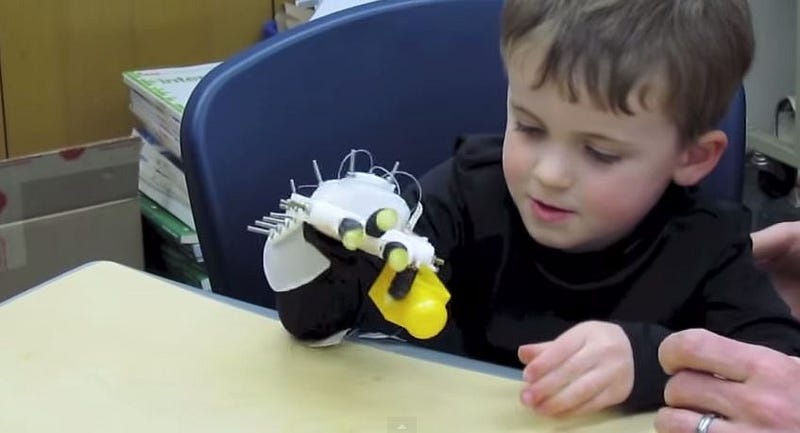
Along those lines, I recently learned of such a real-world, difference-making project spearheaded by Rich Lehrer, a middle school science teacher at Brookwood School in Manchester, Massachusetts. Lehrer’s son, Max, 3, was born with a congenital abnormality which prevented fingers from developing on his right hand.
About a year ago, Lehrer saw a Facebook post about Richard Van As, a South African who, after losing several fingers in a bad carpentry accident, consulted with American designer Ivan Owen to construct his own prosthetic, the “Robohand,” which returned much of his hand’s original function.
In Owen’s TEDx Talk, which he gave in January, he explains how consumer-level 3D-printing allows independent designers a cost-effective means to quickly test out ideas in the real world. “In some applications — and mechanical fingers for children is just one example — it’s even possible for these designs to be ready for use in the real world right after coming off of the printer,” he says. “As a tool for open source development, this makes it possible for people from a very wide range of backgrounds and experience-levels to collaborate with one another.”
Owen’s words hit home with me. I don’t teach science, and I’m only minimally aware of how to use a 3D printer. Too often, though, I see and hear of students creating trinkets and jewelry, and I question the value, or what real difference it makes, when the heated plastic, emanating from the 3D printer, takes shape. But Van As and Owen show how students can make a meaningful and lasting difference, almost immediately, with 3D printing.
Lehrer connected with Van As, wanting to make a similar hand for Max, who had undergone a major operation, in which doctors moved one of his metacarpals to afford a bit better grasp. Lehrer tells me that since then, he and his wife had decided to hold off on any other intervention. But all of that changed when Lehrer watched a video showing the possibilities of a prosthetic hand. Watch the video.
Van As offered to custom-build Max’s Robohand, but Lehrer thought to do it himself. Last summer, he came up with the idea of sponsoring a school club to help with that endeavor. One group would find a 3D-printer to create the most intricate parts, like the fingers and knuckles. Another group would track down thermoplastic, to serve as a splint and hold the hand in place. A third group would locate tools, latex rubber, and orthodontic elastics, listed in the Robohand assembly manual provided by Van As.
As for the 3D-printer, each year several Brookwood graduates attend The Governor’s Academy, a nearby school in Byfield, Massachusetts, where senior Arjun Bhatnagar oversees use of the machine. Lehrer connected with Bhatnagar, who showed immediate excitement about getting involved. “The work I’m doing will have a direct impact on someone,” Bhatnagar says. “It feels really good to really help a child with the work I was trying to do . . . . It was just awesome, the whole idea of something I worked on for hours will now benefit a child who can actually pick up things and do stuff with it.”
I’m equally intrigued by Bhatnagar’s relationship with Lehrer, and how the two represent the best of what can come from students and teachers working together. Bhatnagar speaks glowingly of Lehrer, a “really sunny guy” who is always approachable. For his part, Lehrer describes Bhatnagar as “inspiring,” and says working with a student like him was a “home run.”
“We each had knowledge that one of us knew, and we wanted to share and bring this project to fruition in the end,” Bhatnagar says, noting that he considers Lehrer more his partner than just another teacher. “At the same time, he was willing to let a student take charge of something that he had no idea of, and show him and . . . basically the whole school, what a student can do. He can create a curriculum, create an agenda, create a program, and start some things of his own,” Bhatnagar tells me.
As I listen to Bhatnagar, I find validation of an article I wrote this fall with Preston Michelson, a now-former student, for Independent Teacher Magazine: “In the classroom, no longer are adults the only source of knowledge — and often they aren’t even the best,” we write in A Tale of Two Teachers. “Now more than ever, kids are taking learning into their own hands. The best teachers embrace this development and don’t feel threatened by students who may know more than they do. Instead, they revel in a changing dynamic, in which students and teachers learn together to improve their collective understanding and mastery of relevant subjects and skills.”
Brookwood and Governor’s are independent schools, and Bhatnagar also got me thinking of my trip to Washington, D.C., where along with some 20 of the nation’s top innovators, educators, and change-agents, I participated in an Educational Technology and Blended Learning Summit, hosted by the National Association of Independent Schools. One key consensus called for more independent schools working together, not against each other. That includes sharing not only resources, like the 3D-printer, but also talented and motivated teachers, like Lehrer, who can and should continue to reach students beyond the confines of his daily workplace.
Speaking of which, Lehrer is grateful for deciding to build the Robohand with students. “There was always this sense that it wouldn’t work out, or we wouldn’t be able to do it,” he says. “When all of a sudden we had all the stuff there, that realization on their part and my part that ‘Oh, my God, we are literally going to be able to build my son this little, prosthetic hand.’ It was this moment in teaching . . . I’ve never had anything like it.”
Here’s hoping more teachers follow in Lehrer’s footsteps.
Essay 1.4
Top Five Life Skills Schools Rarely Teach
Original date unconfirmed · June 30, 2018 (Medium archive) · Medium
Read archived article · Source details
Schools place too little stock in teaching kids highly relevant life skills. Here is my top-five list of what schools and teachers fail to do.
We fail at teaching students how to market themselves
If you think “marketing” is a dirty word, and that educators have no business teaching students how to do this, you need to reconsider your role. In today’s digital age, it may be true that plenty of students know how to create digital media, but too few know how to produce high-quality content, the kind that makes them stick out to not only college admission officers, but also potential employers. What does this involve? We need to teach and encourage students to post original, quality content to brand their unique identities in a sea of increasingly indistinguishable resumes — which are going the way of the typewriter. In one class, I encouraged a talented student-journalist to post his work on Pathbrite, an online electronic portfolio that showcases his diverse writing, broadcasting, and reporting talents. I am currently helping a talented student-photographer create her own site, which she will use to brand her creative identity. At the very least, I encourage all of my seniors to create a LinkedIn page.
We fail at allowing students to concentrate deeply on a specific interest or passion
I know I’m not alone in trying to answer students asking, “How is learning this relevant for my life?” We might respond in a number of ways, the most common of which is that it helps strengthen one’s critical thinking and analytic skills. This may be quite true, but in my experience, fewer and fewer students are buying that as enough of a reason to devote years of study to any particular discipline. Instead, teachers need to do two things better. First, through whatever means necessary, we need to do a much better job of helping students identify their passions in life. It’s a shame that many go on from high school without ever knowing what they might love to pursue, even if they end up changing directions. The next step is figuring out a way to make learning math, science, English, history, and language more relevant to each individual student. I don’t have an easy answer for this, but we should consider allowing a student dead-set on pursuing art, for example, to delve deeper into that passion by forgoing an advanced science or English course.
We fail at encouraging students to fail, by harshly penalizing failure
Everything worthwhile I’ve learned in life, I’ve learned because of failure — and repeated failure at that. Too often, we penalize students too harshly for simply progressing through the learning cycle at different speeds. If the end goal is mastery, no matter the subject, why penalize a student for failing a chapter 1 test when she scores much better on the final? Does it really matter when that student displayed mastery throughout the course of the year, so long as she ultimately achieved mastery? How does this in any way reflect real-world expectations? In business, would a boss fire or penalize an employee for not understanding a concept right away? Perhaps, but that’s not somebody I would ever want to work for. It’s also unfair to hold students to expectations that, for the most part, aren’t reflected in how adults in the real world treat each other.
We fail at teaching students financial management
In most schools, American history is a required course; “Financial Responsibility 101” should be, too. I challenge all teachers of juniors and seniors to ask their students how comfortable or competent they feel with managing a credit card, balancing a checkbook, or paying taxes by themselves, right now, without any help from Mom or Dad. I would be shocked to learn that many soon-to-be high school graduates feel ready to use these crucial skills for living a responsible adult life. I’m not saying that learning algebra or calculus isn’t important (it certainly is), but not to the extreme of completely abandoning teaching students about financial management.
We fail at teaching basic repair and maintenance skills
I’m 30 years old, and I can’t even change a tire. I’m not alone. Many of my friends can’t either. And I have highly educated friends. We’ve grown too accustomed to relying on roadside assistance, but I’m screwed if I pop a tire in the middle of a dead zone. I’m also awful at putting together furniture, and I have absolutely no clue about how to complete basic home improvements. Certainly, I shoulder much of the blame. Nothing has stopped me from going out and learning about those things on my own. All the same, why wasn’t this a required course in school? Among all the useful things I learned in the classroom, I wish I had learned how to take care of my home. Today, I would be saving a nice chunk of change.
I don’t mean to say that all schools are alike and that no school addresses any of these needs. I’m sure that some schools already do a terrific job with some of these categories. Still, across the board, a lot more work needs to be done.
Essay 1.5
Why School?: A Conversation Worth Having
Original date unconfirmed · July 9, 2018 (Medium archive) · Medium
Read archived article · Source details
I attended the National Association of Independent Schools (NAIS) Teachers of the Future conference at Episcopal High School in Alexandria, Virginia. It was the single most rewarding experience of my career — never had I met such a collection of bright, passionate, and progressive educators.
We tackled difficult issues, ranging from effective use of classroom technology to how to engage more teachers in online forums. NAIS President John Chubb even spent a morning with us, learning about our ideas on making a positive difference.
Two weeks later, I still can’t shake the belief that what most teachers do, and the ways most schools operate are not only antiquated, but also sharply antithetical to how 21st-century students acquire knowledge. More and more, our students are discovering how to use the Internet for self-directed learning, geared to individual interests. A disconnect exists between how and what students learn in school, and what skills and knowledge they will need to succeed and function beyond a classroom.
To show that I’m in good company, my fellow Teachers of the Future suggested that I read Will Richardson’s short but insightful book, Why School? How Education Must Change When Learning and Information Are Everywhere.
“Based on visits to hundreds of schools in the past few years, I’d estimate that 95 percent of them are doing little or nothing to truly prepare their students for the world as it currently exists,” Richardson writes. “Connecting and learning with other people online, distinguishing good information from bad, creating and sharing important works with the world: None of that (and a whole bunch of other stuff I could mention) is on the test. And sadly, therefore, we don’t value it. It finds no place in our classrooms.”
I couldn’t agree more. Educators are doing too little to make learning relevant. To change this, we must first reconsider much of the traditional curriculum. I enjoy teaching history, but I’m not naïve. After completing the final, most students will not remember the Gilded Age.
And why should they?
How will that knowledge help them succeed after college? I’m not suggesting that a basic understanding of American history, or any subject for that matter, isn’t a worthy mission. But we need to place an equal emphasis on allowing and encouraging students to explore and share their own ideas — and strengthen a passion for creativity and individual inquiry.
All the same, I reach out to ask Richardson if students might suffer from an emphasis on individual-based inquiry, especially at the expense of not learning as much traditional content:
“We make choices about what we want kids to learn,” Richardson says. “They need to learn Shakespeare. They have to learn algebra, because if they don’t get those things from us, they’re not going to get [that] anywhere else. Even though we know, I think, in our heart of hearts that not everybody needs two years of algebra or not everybody needs calculus, we think that we need, as a school system, to make sure they get it — just in case they pursue that direction they need that type of information at some point. My kids live in a different world now. The reality of it is, for most adults, if you went back and had them take that Algebra II test, we’d fail miserably, because it’s just stuff that we’ve never used — and we never will use.”
With the advent of Web 2.0, Richardson reaffirms my belief that teachers are no longer the only source of classroom knowledge — and not even the best.
“It’s not just, ‘I’m going to impart the knowledge to you’ anymore, because Google is going to do a better job of that than you can,” he says. “Basically, it’s, ‘How can I help you develop the dispositions that you need to really be patient, to be persistent, to deal with failure, to embrace failure, to embrace change?’”
Our role as teachers will need to change to resemble that of a coach or mentor. We will need to guide students to pursue worthy questions in the context of areas that interest them. In that learning environment, I see no place for expecting students to memorize mountains of data — especially when doing so won’t cultivate creativity, passion, and innovation. It also makes no sense to quiz students on minutiae that a Google search will easily provide.
Richardson tells me about his daughter’s experience taking United States History in high school. For the final, she had a 100‑question, multiple‑choice test: “Can my daughter do something with that knowledge? Can she actually create something?”
It’s no wonder that so many students are bored and frustrated at school. In an age of innovation and self-discovery, for the most part, we subject our students to scripted learning. This has to change.
What I Reconsidered
Knowing history and doing something with it
I enjoy teaching history, but I’m not naïve. After completing the final, most students will not remember the Gilded Age. And why should they?
Real historical thinking requires knowledge of the material itself: context, chronology, cause and effect, and the ways historians have argued about the past over time. Without that, teachers are not helping students discover the truth about America’s past.
Freedom within clear expectations
Students need structure. But they also need freedom to explore what matters to them, within the context of a given subject.