Find individual lessons, handouts, and teaching tools below. For unit sequences and classroom schedules, open a full course plan.
Find a teaching resource
Results update as you type. Press Search or Enter to jump to them.
Filter by grade, standard, type, format, unit & time
Grades are suggested placements. CED = College Board Course and Exam Description; C3 = College, Career, and Civic Life Framework for Social Studies State Standards. Connections identify skills or topics a resource supports, not full standards coverage. Time filters use documented durations.
118 resources across all subjects · Shared activities appear in each relevant course.
34 RESOURCES · 5 UNITS
U.S. History
The early republic, Hamilton, historical interpretation, enslavement, and agency.
Open current unit assignment sheets and older courses, archived full-year schedules and semester plans: American History, AP Government, Latin American History, Philosophy of Government, and American Judaism & Popular Culture.
Direct links to current unit sheets, five complete archived course plans, and unit or month browsing
Access
Public; archived dates belong to the original course
Time
Flexible · see resource directions
Planning notes & adaptation
Planning goal: Select a course plan or assignment sheet and adapt its sequence to your own class.
Prepare: Choose the subject and current unit or archived course. Check the original dates, assigned readings, and access requirements.
Adapt: Use the plan to organize lessons and checkpoints. Replace dates and school-specific directions, and confirm that your students can access the selected readings.
Before use: Before sharing, verify the revised calendar, assignment links, reading access, and workload. This directory is a planning resource, not a student assessment.
Also useful in U.S. History and AP U.S. Government & Politics and Journalism.
Complete assignment, 200-point rubric, timeline, source requirements, and all original Canvas resource and download links
Access
Assignment public; Canvas readings may require school login
Time
March–May 2027
Teaching notes & learning target
Learning target: Develop a sustained historical argument about Truman’s decision to use atomic weapons, weighing evidence and competing interpretations.
Prepare: Read the full assignment, 200-point rubric, source requirements, and checkpoints. Verify access to linked readings and adapt the March–May calendar.
Teach: Guide students from a research question through source evaluation, a working thesis, drafting, and revision. Require them to address competing interpretations with documented evidence.
Check learning: Use the assignment’s checkpoints and rubric to assess the argument, evidence, analysis, and citations in the final 7–10-page paper.
U.S. History · grade 11. Adapt dates and section labels in the original plans to your own calendar.
Unit 2 · The Early Republic & the Making of a Nation 14 resources
Unit overview & assignment sheet
UNIT FOCUS
Evaluate how historical evidence and popular storytelling shape our understanding of the founding era.
END-OF-UNIT WORK
Hamilton: history, interpretation & public memory
Compare Brockenbrough’s biography with the musical in an evidence-based, in-class essay.
Objectives, sources, student handout, teacher guide, differentiation, rubric, and AI-generated model response
Access
Public; separate student and teacher downloads
Time
50 minutes · suggested plan
Teaching notes & learning target
Learning target: Distinguish a chronological sequence from a causal explanation. Connect a grievance to a theory of legitimate government. Compare Parliament, a colonial Loyalist, and Congress while accounting for audience, purpose, and date.
Prepare: Print the included three-source packet and student tasks. All required excerpts are included; the source links provide full transcriptions. Review the timeline together. Seabury wrote in 1774, before fighting began; Congress issued the Declaration in 1776 after war had begun. These are not simultaneous replies. Explain that the excerpts preserve historical wording. Context notes and vocabulary are instructional additions, not quotations. No account or prior homework is required.
Teach: Do not frame colonists as a unanimous group or the Revolution as inevitable. The universal language of rights coexisted with enslavement and political exclusion; identify that contradiction without implying the Declaration abolished slavery. Seabury’s 1774 pamphlet is not a response to the 1776 Declaration. The comparison traces competing arguments across time. The Declaratory Act excerpt represents Parliament’s formal claim. Seabury supplies a colonial Loyalist argument; keep these perspectives distinct. Ask students to test both authors’ claims about petitions rather than rewarding whichever side they favor. These excerpts cannot establish the views of every colonial community.
Check learning: Why does “taxes were too high” provide an incomplete explanation of the Revolution?
U.S. History · grade 11. Adapt dates and section labels in the original plans to your own calendar.
Developed with ChatGPT, reviewed and adopted by David Cutler for classroom use. AI-generated models and fictional examples are labeled transparently.
Objectives, sources, student handout, teacher guide, differentiation, rubric, and AI-generated model response
Access
Public; separate student and teacher downloads
Time
50 minutes · suggested plan
Teaching notes & learning target
Learning target: Identify state and congressional powers in the Articles. Apply institutional rules to a fictional funding problem. Explain a tradeoff in a proposed reform.
Prepare: Print the rule cards and scenario below. Keep discussion focused on institutions; students need not impersonate historical people.
Teach: Distinguish ordinary decisions, specified nine-state decisions, and amendment rules. The Articles government conducted diplomacy and other national business; avoid saying it could do nothing.
Check learning: Explain how a rule designed to protect states could also obstruct collective action.
U.S. History · grade 11. Adapt dates and section labels in the original plans to your own calendar.
Developed with ChatGPT, reviewed and adopted by David Cutler for classroom use. AI-generated models and fictional examples are labeled transparently.
Objectives, sources, student handout, teacher guide, differentiation, rubric, and AI-generated model response
Access
Public; separate student and teacher downloads
Time
50 minutes · suggested plan
Teaching notes & learning target
Learning target: Separate historical claim, artistic choice, and interpretation. Compare a selected scene with a biography passage. Develop a qualified argument using precise references.
Prepare: Review the linked full essay assignment and its 60-point rubric. This 50-minute lesson prepares students for that separate two-period essay. Select one previously taught scene and a corresponding biography passage; record the exact scene/time range and chapter/pages on the handout. Provide lawful access to both works. The package supplies the worksheet and guidance, not the film, lyrics, or book. For a 50-minute lesson, viewing and reading occur before class; use notes during class.
Teach: The biography is an interpretation too; disagreement with it is not automatically proof of error. Avoid a single universal model paragraph that invents details about whichever scene a teacher selects.
Check learning: When is an omission historically significant rather than simply unavoidable?
U.S. History · grade 11. Adapt dates and section labels in the original plans to your own calendar.
Developed with ChatGPT, reviewed and adopted by David Cutler for classroom use. AI-generated models and fictional examples are labeled transparently.
Unit 3 · Enslavement, Agency & Sectional Conflict 17 resources
Unit overview & assignment sheet
UNIT FOCUS
Explain how people exercised agency under coercion and how slavery’s expansion deepened sectional conflict.
END-OF-UNIT WORK
Agency under constraint · final essay
Develop a 4–5-page historical argument using Jacobs, additional evidence, and Chicago footnotes, with staged planning and revision.
Objectives, sources, student handout, teacher guide, differentiation, rubric, and AI-generated model response
Access
Public; separate student and teacher downloads
Time
50 minutes · suggested plan
Teaching notes & learning target
Learning target: Identify an action, a goal, and a coercive constraint in a primary source. Distinguish a narrator’s retrospective purpose from the events narrated. Explain agency without equating it with freedom or success.
Prepare: Print the excerpts below and introduce the terms agency, coercion, and retrospective narration. Use a teacher-led discussion; do not assign enslaver/enslaved role-play or ask students to imagine choosing under enslavement.
Teach: Do not rank whose resistance was more courageous or suggest people were responsible for failing to escape. Jacobs’s authorship and Child’s editorial role should not be conflated. The excerpts are Jacobs’s narrative and preface.
Check learning: In one sentence, explain why agency is not the same as freedom.
U.S. History · grade 11. Discuss coercion and violence through evidence; avoid role-playing enslavement.
Developed with ChatGPT, reviewed and adopted by David Cutler for classroom use. AI-generated models and fictional examples are labeled transparently.
Write a 4–5-page argument about the possibilities and limits of agency in Harriet Jacobs’s narrative, with another person’s or group’s act of agency. Takaki is an optional source for that comparison.
Try the student writing editor and teacher feedback dashboard with fictional work. Download the notebook source code, customize assignment directions, and embed the student notebook in an LMS.
Footnotes, Word export, draft history, teacher demo, source code ZIP and setup guide
Access
Public demo and free code download; connected classroom dashboard requires setup
Time
Flexible · see resource directions
Teaching notes & learning target
Learning target: Use the notebook to draft, cite sources, review feedback, and export writing for submission.
Prepare: Try the student editor and teacher demo with fictional work. Review the setup guide; a connected teacher dashboard requires additional setup.
Teach: Demonstrate drafting, footnotes, saved versions, feedback, and Word export. Set assignment directions and explain how students will save and submit through your LMS.
Check learning: Have students save and export a short practice draft with a footnote, then confirm that they can reopen the file and follow your submission process.
Also useful in U.S. History and AP U.S. Government & Politics and Journalism.
57 RESOURCES · 5 UNITS
AP U.S. Government & Politics
Constitutional foundations, political ideology, socialization, polling, public policy, and AP practice.
Open current unit assignment sheets and older courses, archived full-year schedules and semester plans: American History, AP Government, Latin American History, Philosophy of Government, and American Judaism & Popular Culture.
Direct links to current unit sheets, five complete archived course plans, and unit or month browsing
Access
Public; archived dates belong to the original course
Time
Flexible · see resource directions
Planning notes & adaptation
Planning goal: Select a course plan or assignment sheet and adapt its sequence to your own class.
Prepare: Choose the subject and current unit or archived course. Check the original dates, assigned readings, and access requirements.
Adapt: Use the plan to organize lessons and checkpoints. Replace dates and school-specific directions, and confirm that your students can access the selected readings.
Before use: Before sharing, verify the revised calendar, assignment links, reading access, and workload. This directory is a planning resource, not a student assessment.
Objectives, sources, student handout, teacher guide, differentiation, rubric, and AI-generated model response
Access
Public; separate student and teacher downloads
Time
50 minutes · suggested plan
Teaching notes & learning target
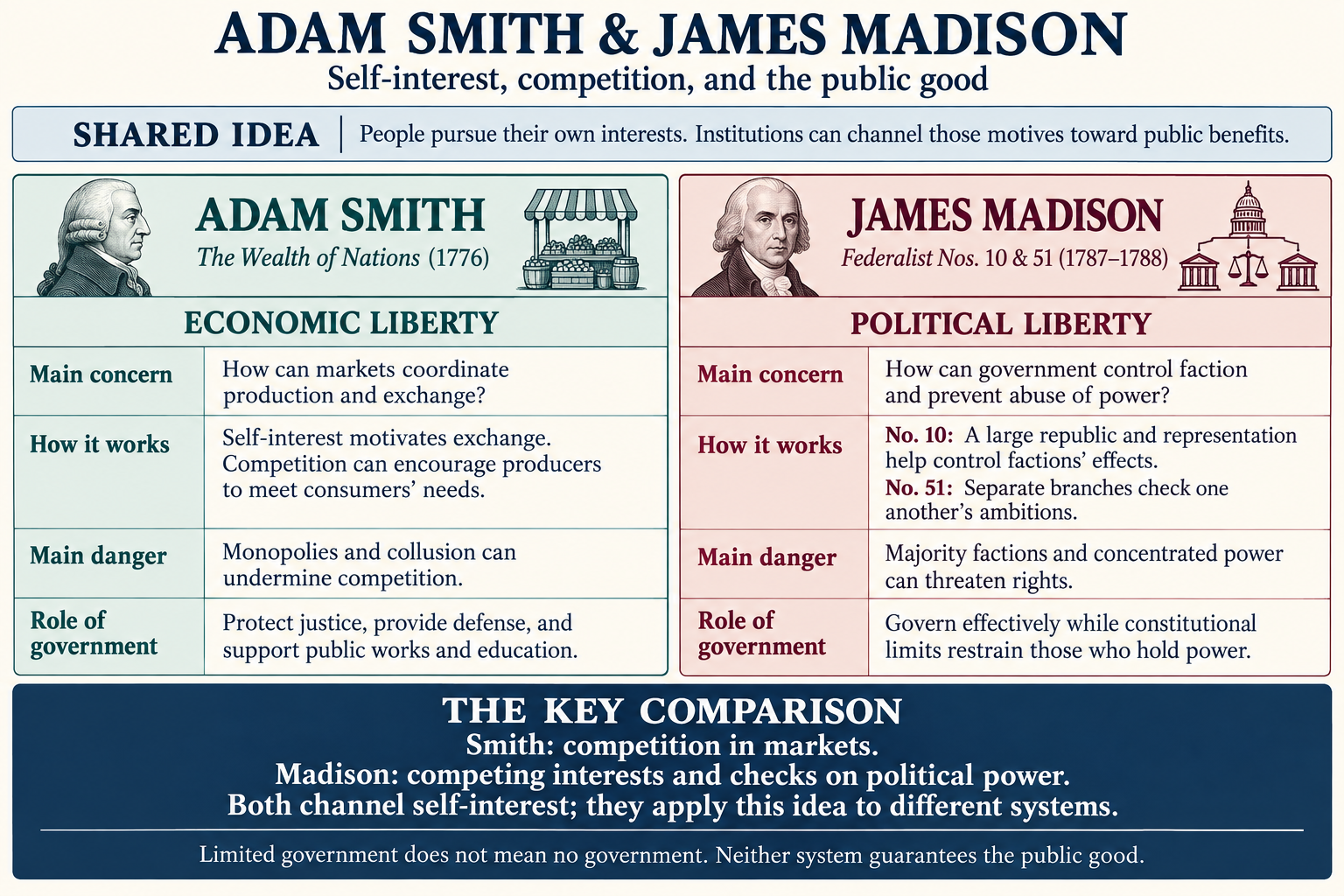
Learning target: Explain Madison’s response to majority faction. Explain Brutus’s concern about an extensive republic. Apply both arguments to the same original scenario.
Prepare: Print the excerpts and original scenario. Use this as Unit 1 source analysis; it is independent practice, not an official College Board question.
Teach: Both writers care about republican liberty; avoid reducing the debate to one supporting democracy and the other opposing it. Do not substitute today’s political parties for eighteenth-century arguments.
Check learning: How can the same feature—a large, diverse population—support opposing conclusions?
Objectives, sources, student handout, teacher guide, differentiation, rubric, and AI-generated model response
Access
Public; separate student and teacher downloads
Time
50 minutes · suggested plan
Teaching notes & learning target
Learning target: Separate a legal right from a court’s authority to grant a remedy. Explain the constitutional conflict in Marbury. Apply judicial review without assuming courts may hear every dispute.
Prepare: Print the case brief and task sheet. Use the decision summary as the common evidence base; no student code is needed.
Teach: Keep Marbury as an example of judicial review; avoid claiming it made every judicial action unreviewable. This exercise assesses reasoning about the case, not memorization of all procedural details.
Check learning: What did Marbury not receive, and what principle did the Court articulate?
Objectives, sources, student handout, teacher guide, differentiation, rubric, and AI-generated model response
Access
Public; separate student and teacher downloads
Time
50 minutes · suggested plan
Teaching notes & learning target
Learning target: Distinguish enumerated ends from implied means. Explain the bank and tax holdings in McCulloch. Apply the reasoning to a new federalism scenario with a stated limit.
Prepare: Print the brief and constitutional connection cards. Use Unit 1 vocabulary; this is original classroom practice rather than an official AP rubric.
Teach: Do not replace “necessary and proper” with a free-standing claim of unlimited convenience. Assess the stated hypothetical; avoid presenting it as advice about an actual tax dispute.
Check learning: Why does “not expressly named” fail to settle whether Congress may create an institution?
Objectives, sources, student handout, teacher guide, differentiation, rubric, and AI-generated model response
Access
Public; separate student and teacher downloads
Time
50 minutes · suggested plan
Teaching notes & learning target
Learning target: Read percentages and calculate percentage-point differences. Distinguish probability sampling from voluntary response. Revise a leading question and state a defensible conclusion.
Prepare: Print the fictional data table and question wording. Tell students explicitly that the figures are invented for instruction and are not evidence about actual voters.
Teach: The supplied margin concerns a single estimate; do not use it as an automatic margin for a difference. These data are deliberately fictional and must remain labeled in any reused slide or handout.
Check learning: Why can a 2,000-response poll be less informative than an 800-response poll?
Objectives, sources, student handout, teacher guide, differentiation, rubric, and AI-generated model response
Access
Public; separate student and teacher downloads
Time
50 minutes · suggested plan
Teaching notes & learning target
Learning target: Identify agents of political socialization. Explain a plausible mechanism of influence using evidence. Distinguish life-cycle, generational, and period explanations.
Prepare: Print the fictional profiles. Do not ask students to disclose family votes, party identity, or personal political beliefs. Use the cases as Unit 4 practice; all profiles are invented.
Teach: The lesson studies processes, not students’ personal ideologies. Avoid teaching that every age difference is a life-cycle effect.
Check learning: Why does an age difference measured once fail to prove that aging caused the difference?
Practice open; final tests and teacher keys require approval
Time
Flexible · see resource directions
Teaching notes & learning target
Learning target: Apply voting rights and models of voting behavior to a concrete political scenario.
Prepare: Open “Unit 5: Political Participation · Complete Review Hub” and identify the political actors, their powers, and the policy outcome students must explain.
Teach: Work through one scenario together, then ask students to explain how changing one institution or incentive could alter the result.
Check learning: Collect a short explanation naming the political mechanism and the evidence supporting it.
Related CED objectives: LO 5.1.A · LO 5.2.A · LO 5.3.A · LO 5.4.A · LO 5.5.A · LO 5.6.A · LO 5.7.A · LO 5.8.A · LO 5.9.A · LO 5.10.A · LO 5.11.A · LO 5.12.A · LO 5.13.A · LO 5.1.B · LO 5.3.B · LO 5.6.B · LO 5.8.B
Practice open; final tests and teacher keys require approval
Time
Flexible · see resource directions
Teaching notes & learning target
Learning target: Apply ideals of democracy to a concrete political scenario.
Prepare: Open “Units 1, 4 & 5: Cumulative Practice” and identify the political actors, their powers, and the policy outcome students must explain.
Teach: Work through one scenario together, then ask students to explain how changing one institution or incentive could alter the result.
Check learning: Collect a short explanation naming the political mechanism and the evidence supporting it.
Related CED objectives: LO 1.1.A · LO 1.2.A · LO 1.3.A · LO 1.4.A · LO 1.5.A · LO 1.6.A · LO 1.7.A · LO 1.8.A · LO 1.9.A · LO 4.1.A · LO 4.2.A · LO 4.3.A · LO 4.4.A · LO 4.5.A · LO 4.6.A · LO 4.7.A · LO 4.8.A · LO 4.9.A · LO 4.10.A · LO 5.1.A · LO 5.2.A · LO 5.3.A · LO 5.4.A · LO 5.5.A · LO 5.6.A · LO 5.7.A · LO 5.8.A · LO 5.9.A · LO 5.10.A · LO 5.11.A · LO 5.12.A · LO 5.13.A · LO 4.9.B · LO 4.10.B · LO 5.1.B · LO 5.3.B · LO 5.6.B · LO 5.8.B
Learning target: Apply voting rights and models of voting behavior to a concrete political scenario.
Prepare: Open “Voting rights and voter decisions” and identify the political actors, their powers, and the policy outcome students must explain.
Teach: Distinguish constitutional and statutory voting protections from models explaining an individual voter’s choice. Apply each to a separate example.
Check learning: Identify a voting protection and explain a voter-decision model without confusing their functions.
Try the student writing editor and teacher feedback dashboard with fictional work. Download the notebook source code, customize assignment directions, and embed the student notebook in an LMS.
Footnotes, Word export, draft history, teacher demo, source code ZIP and setup guide
Access
Public demo and free code download; connected classroom dashboard requires setup
Time
Flexible · see resource directions
Teaching notes & learning target
Learning target: Use the notebook to draft, cite sources, review feedback, and export writing for submission.
Prepare: Try the student editor and teacher demo with fictional work. Review the setup guide; a connected teacher dashboard requires additional setup.
Teach: Demonstrate drafting, footnotes, saved versions, feedback, and Word export. Set assignment directions and explain how students will save and submit through your LMS.
Check learning: Have students save and export a short practice draft with a footnote, then confirm that they can reopen the file and follow your submission process.
Open current unit assignment sheets and older courses, archived full-year schedules and semester plans: American History, AP Government, Latin American History, Philosophy of Government, and American Judaism & Popular Culture.
Direct links to current unit sheets, five complete archived course plans, and unit or month browsing
Access
Public; archived dates belong to the original course
Time
Flexible · see resource directions
Planning notes & adaptation
Planning goal: Select a course plan or assignment sheet and adapt its sequence to your own class.
Prepare: Choose the subject and current unit or archived course. Check the original dates, assigned readings, and access requirements.
Adapt: Use the plan to organize lessons and checkpoints. Replace dates and school-specific directions, and confirm that your students can access the selected readings.
Before use: Before sharing, verify the revised calendar, assignment links, reading access, and workload. This directory is a planning resource, not a student assessment.
Also useful in U.S. History and AP U.S. Government & Politics and Journalism.
Objectives, sources, student handout, teacher guide, differentiation, rubric, and AI-generated model response
Access
Public; separate student and teacher downloads
Time
50 minutes · suggested plan
Teaching notes & learning target
Learning target: Write open-ended questions and evidence-seeking follow-ups. Distinguish observation, quotation, and interpretation. Produce an accurately attributed short profile.
Prepare: Print the fictional interview record. Optional partner interviews should concern ordinary school activities and require the partner’s agreement. Use the supplied record for students who prefer not to be interviewed. No recording is required.
Teach: Do not improve quotations by changing their wording. Use an accurate paraphrase when clarity requires it. Profiles can be appreciative without becoming promotional; seek complexity and independent corroboration.
Check learning: Why is a plausible detail still unacceptable if it was not reported?
Suggested high school use. C3 connections describe transferable inquiry and civic skills; they are not a journalism accreditation.
Developed with ChatGPT, reviewed and adopted by David Cutler for classroom use. AI-generated models and fictional examples are labeled transparently.
Objectives, sources, student handout, teacher guide, differentiation, rubric, and AI-generated model response
Access
Public; separate student and teacher downloads
Time
50 minutes · suggested plan
Teaching notes & learning target
Learning target: Distinguish a claim from supporting evidence and unsupported assertion. Address a meaningful counterargument fairly. Propose an action proportionate to the available evidence.
Prepare: Print the original fictional fact bank. Students can use the provided evidence; no interviews or personal disclosures are required.
Teach: Do not reward the strength of a student’s indignation; assess the quality of the reported argument. A counterargument deserves accurate treatment even if the writer ultimately rejects it.
Check learning: What would you need to verify before calling the proposal affordable?
Suggested high school use. C3 connections describe transferable inquiry and civic skills; they are not a journalism accreditation.
Developed with ChatGPT, reviewed and adopted by David Cutler for classroom use. AI-generated models and fictional examples are labeled transparently.
David Cutler’s presentation for the Fall JEA/NSPA National High School Journalism Convention, Nov. 19–22, 2026, in Orlando. Build a reported argument and explore outstanding student work.
Objectives, sources, student handout, teacher guide, differentiation, rubric, and AI-generated model response
Access
Public; separate student and teacher downloads
Time
50 minutes · suggested plan
Teaching notes & learning target
Learning target: Separate verified facts, allegations, and unknowns. Evaluate public interest and foreseeable harm. Recommend a publication decision with conditions and an explanation.
Prepare: Print the fictional case and decision matrix. Keep discussion hypothetical; students should not name real classmates or disclose personal experiences.
Teach: Do not use this exercise to solicit or investigate actual allegations in class. If a real dispute arises, school context and applicable law require qualified guidance; this lesson assesses editorial reasoning.
Check learning: Why does an opportunity to respond not substitute for independent verification?
Suggested high school use. C3 connections describe transferable inquiry and civic skills; they are not a journalism accreditation.
Developed with ChatGPT, reviewed and adopted by David Cutler for classroom use. AI-generated models and fictional examples are labeled transparently.
David Cutler’s presentation for the Fall JEA/NSPA National High School Journalism Convention, Nov. 19–22, 2026, in Orlando. Explore PSJA’s Model Affirmation and how schools can sign on.
Learning target: Explain how a private school can commit to student editorial independence through PSJA’s Model Affirmation.
Prepare: Open the Beyond New Voices presentation and linked model affirmation. Review your school’s existing publication policies before discussing possible commitments.
Teach: Distinguish public-school legal protections from private-school policy commitments. Examine the affirmation’s terms and exceptions, then identify questions to discuss with student editors and administrators.
Check learning: Draft a proposal identifying a specific protection, the relevant affirmation language, and a practical next step toward school consideration.
Suggested high school use. C3 connections describe transferable inquiry and civic skills; they are not a journalism accreditation.
Objectives, sources, student handout, teacher guide, differentiation, rubric, and AI-generated model response
Access
Public; separate student and teacher downloads
Time
50 minutes · suggested plan
Teaching notes & learning target
Learning target: Assign distinct reporting, editing, verification, and publication responsibilities. Diagnose workflow bottlenecks. Build a realistic assignment plan with clear handoffs.
Prepare: Download the existing story tracker or print the paper tracker below. Use fictional assignments rather than real student performance or disciplinary information.
Teach: Do not turn the tracker into a ranking of students. Its purpose is shared accountability and visible next steps. Avoid treating adviser approval as a required publication stage when student editors retain final authority.
Check learning: What information must the next editor receive to take responsibility for a story?
Suggested high school use. C3 connections describe transferable inquiry and civic skills; they are not a journalism accreditation.
Developed with ChatGPT, reviewed and adopted by David Cutler for classroom use. AI-generated models and fictional examples are labeled transparently.
Objectives, sources, student handout, teacher guide, differentiation, rubric, and AI-generated model response
Access
Public; separate student and teacher downloads
Time
50 minutes · suggested plan
Teaching notes & learning target
Learning target: Evaluate coverage and usability using observable evidence. Distinguish an editorial problem from a personal design preference. Propose a measurable improvement with an owner and deadline.
Prepare: Choose a public student publication, or use the fictional audit packet below if internet access is unavailable. Print one audit handout per student. Students inspect only public pages and do not change the publication.
Teach: These classroom criteria are not an official contest rubric or promise of awards. Do not equate a polished homepage with strong reporting; verify the content beneath it.
Check learning: What makes a redesign recommendation evidence-based?
Suggested high school use. C3 connections describe transferable inquiry and civic skills; they are not a journalism accreditation.
Developed with ChatGPT, reviewed and adopted by David Cutler for classroom use. AI-generated models and fictional examples are labeled transparently.
Try the student writing editor and teacher feedback dashboard with fictional work. Download the notebook source code, customize assignment directions, and embed the student notebook in an LMS.
Footnotes, Word export, draft history, teacher demo, source code ZIP and setup guide
Access
Public demo and free code download; connected classroom dashboard requires setup
Time
Flexible · see resource directions
Teaching notes & learning target
Learning target: Use the notebook to draft, cite sources, review feedback, and export writing for submission.
Prepare: Try the student editor and teacher demo with fictional work. Review the setup guide; a connected teacher dashboard requires additional setup.
Teach: Demonstrate drafting, footnotes, saved versions, feedback, and Word export. Set assignment directions and explain how students will save and submit through your LMS.
Check learning: Have students save and export a short practice draft with a footnote, then confirm that they can reopen the file and follow your submission process.
Also useful in U.S. History and AP U.S. Government & Politics and Journalism.
Assignment sheets, assessments & curriculum maps
AP U.S. GOVERNMENT · START WITH THE UNIT PLAN
Assignment sheets & unit review sites
See the daily classwork, homework, readings, and deadlines before exploring individual lessons. Dates belong to the original classroom plans; adapt them to your schedule.
Start with the course expectations and unit plans, then explore the lessons below. Dates belong to the original classroom plans; adapt them to your schedule.
UNIT 1
Course Goals & Classroom Protocols
Introductory course documents; no separate dated assignment sheet.
History curriculum materials are open. No prior approval is required.
AP Government curriculum map · all five CED units
College Board’s Course and Exam Description (CED), effective fall 2026, supplies the topic numbers and learning objective codes. Lesson connections are suggested alignments for these resources, not College Board endorsements. Open a lesson’s teaching notes for its learning target and related objective codes.
Units 1, 4, and 5 contain current materials. I will add Units 2 and 3 once they are redesigned; use the 2025–2026 curriculum and its topic-to-lesson map in the meantime. An individual lesson may support part of a topic; a link does not mean the full topic is covered.
Explore guidance and publication checklists, with an introductory video and a place to share feedback.
Curious about my assessment tool?
Try a short sample test and explore the teacher view using fictional records. Read how the tool saves work, records focus changes, and supports independent thinking.
The free student notebook saves in each student’s browser; students download their work and submit it through your LMS. A connected teacher dashboard requires separate technical setup. Try the fictional demo, or use the source code and ChatGPT instructions to build your own.